

Pay attention when someone talks about Brain Computer Interfaces (BCI), because they’ll be here in basic format by about 2029, co-incidentally when Ray Kurzweil believes the Singularity will arrive.
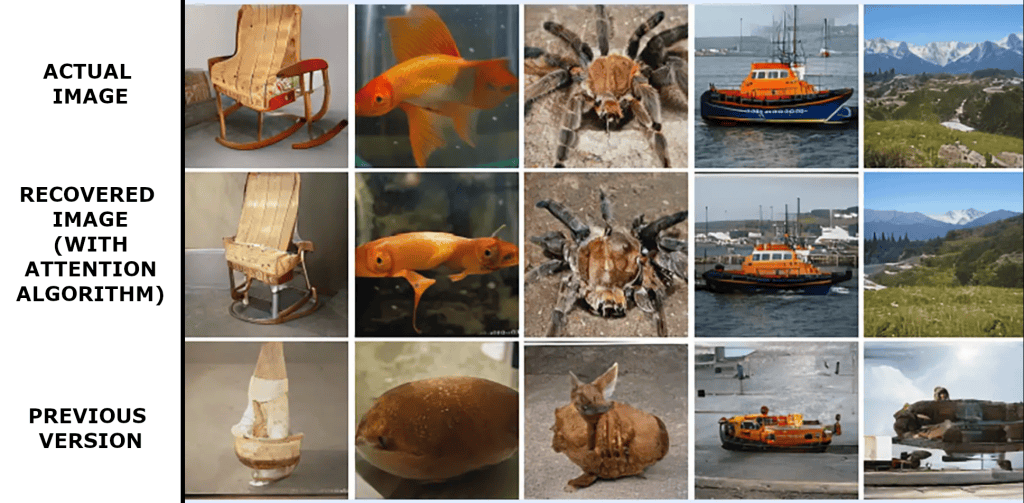
Researchers have successfully reconstructing images from brain activity, something considered to be a significant breakthrough in the field of neuroscience and artificial intelligence (AI). This remarkable feat was accomplished by scientists at Radboud University in the Netherlands who are using an “improved” mind-reading AI system. Human volunteers were put inside a functional magnetic resonance imaging (fMRI) machine to measure changes in blood flow in the brain, something that can be used to understand brain activity and the MRI captured the neural activity in their visual cortex, which was then fed into the AI algorithm and the image recreated. (This is the lower set of pictures but shows how external reading of the BCI is progressing).
In a second study, electrode arrays were implanted in a macaque monkey’s brain to record its activity as it looked at AI-generated images and the readings reanalyzed – these produced the middle line of images – using a system called “Directed Attention” where the AI system learns which parts of the brain to focus on and where the AI is learning when interpreting the brain signals where it should direct its attention.
The application of this technology span various fields, giving new possibilities for restoring vision, or creating vision for the blind and also for mapping brain pathways and transmitting these to sensors elsewhere in the body, thus bypassing disabilities caused by spinal breaks or Parkinson’s nerve breakdowns – using new routes for passing messages from the brain.
Considering the speed of progress in the field of generative modelling, the framework will likely result in even more impressive reconstructions of perception and possibly even imagery in the very near future.
It is particularly spectacular given that the AI is imaging a monkey brain and not a human brain and as the Singularity approaches, the speed of change and acceleration of knowledge of BCI will be as spectacular as with pre-trained transformers and LLMs such as Chat-GPT. The speed of change could be as fast as the speed of change for Chat-GPT – we are effectively where Chat-GPT2 beta was in terms of BCI so within a few years, we could be adapting the unthinkable….and that means thought crime could technically become possible.

See their new paper at
https://www.biorxiv.org/content/10.1101/2024.06.04.596589v1.abstract